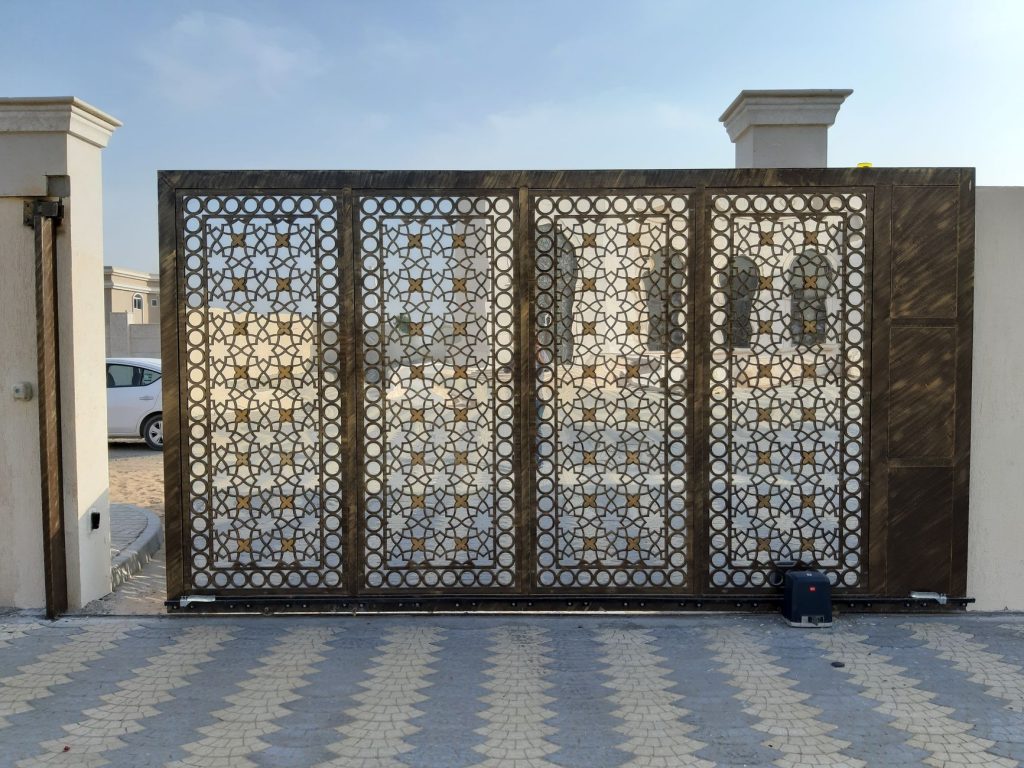
If you’ve come across a reference like « profil 100×54 » while shopping for a sliding gate, it refers to the cross-section of the vertical aluminum posts used in the gate’s frame, 100mm by 54mm. This is one of the most common structural dimensions in the mid-to-high range of aluminum sliding gates sold in France, and understanding it helps you compare quotes that otherwise look identical on paper.
What the 100×54 designation actually describes
According to a technical datasheet published by the retailer cloture-a-domicile.fr, the 100×54 range uses vertical posts (montants) measuring 100mm x 54mm, paired with upper and central crossbeams (traverses) of 90mm x 36mm. A separate product sheet from fermeture-online.com, describing its LEV model, lists the same 100mm x 54mm vertical posts with a 2mm wall thickness, combined with horizontal crossbeams of 90mm x 44mm and 90mm x 36mm, also 2mm thick.

In practice, this means the number sequence you see in a product code, 100, 54, and sometimes a secondary figure like 70 or 90, is shorthand for the post width, post depth, and crossbeam size. Manufacturers use these codes internally to track catalog variants, which is why the same physical gate can appear under different reference numbers depending on the retailer or regional distributor.
How it compares to other common profiles
Not every aluminum sliding gate uses this exact sizing. Gedimat’s THÉA model, a sliding gate sold in a 1.68m height and 4m width configuration, uses noticeably lighter components: 70mm x 40mm uprights and 60mm x 28mm crossbars, with vertical infill tubes of 70mm. That gate weighs 74kg and is listed at €2,485 including tax, according to the product page on gedimat.fr.
The gap between the two profile families is significant. A 100×54 frame carries more metal per linear meter, which generally translates into:
- Better resistance to wind load and sagging over long spans (useful for gates wider than 4m)
- Higher weight capacity, which matters if the gate will be motorized
- A higher price per linear meter than lighter profiles like 70×40
Why the reference code matters when motorizing
Several manufacturers, including the Gedimat THÉA listing, specifically flag their gates as « motorizable, » and reinforced lower crossbeams are a recurring feature across the catalogs reviewed. This reinforcement exists because a sliding gate motor pushes and pulls against the bottom rail repeatedly, and a thin or unreinforced crossbeam will flex or crack over years of daily use. If you’re planning to add an automatic opener, checking the crossbeam gauge, not just the post size, is just as important as the headline profile number. For a broader comparison of opener types, the guide on motorisation portail battant : 4 solutions principales covers swing-gate motors, though the mechanical principles around load and reinforcement carry over to sliding systems as well.
Reading a supplier’s reference code
Codes like the one in this query typically combine several pieces of information in one string: a brand or model abbreviation, the profile dimensions, and an internal catalog or batch number. None of this is standardized across manufacturers, there is no European or French norm that forces every supplier to use the same numbering. That’s why the same physical product can carry a completely different code at two different retailers, and why a search engine query built from a scanned invoice or a supplier’s internal spec sheet often returns little outside that supplier’s own catalog.
If you’re trying to match a specific code to a product, the fastest path is usually:
- Searching the exact string alongside the supplier’s name, if known
- Contacting the retailer or installer who issued the quote or invoice referencing the code
- Asking for the underlying dimensions (post size, crossbeam size, wall thickness) rather than the code itself, these are the figures that actually determine strength and compatibility with motors or accessories
What to check before ordering a 100×54 gate
Beyond the raw post dimensions, a few practical points are worth confirming with any supplier:
| Check | Why it matters |
|---|---|
| Wall thickness (mm) | Two profiles can share the same 100×54 outer size but differ in rigidity if the metal gauge is thinner |
| Crossbeam size and position | A reinforced lower crossbeam is what actually resists motor stress over time |
| Finish and color coating | Anthracite gray (RAL 7016) is the most common finish across the catalogs reviewed |
| Delivery lead time | Gedimat lists its THÉA model as available within 10 days; custom profiles can take longer |
Once the gate itself is sorted, don’t overlook the supporting structure. The posts the gate slides against need to be sized for the weight of the leaf, our guide on poteau de portail : profondeur, diamètre et pose walks through the depth and diameter needed for a stable installation, and if you’re still comparing material families, the overview on portail coulissant : installation et prix covers installation steps and typical pricing for sliding gates more broadly.
Un devis à demander ?
Dites quelle prestation vous cherchez et dans quelle commune : la demande est enregistrée, jamais envoyée automatiquement à une entreprise.
The bottom line
A code mentioning « 100×54 » is referring to a mainstream, mid-to-heavy-duty aluminum sliding gate post profile, not a niche or discontinued part. Confirmed specs from two independent retailer datasheets (cloture-a-domicile.fr and fermeture-online.com) show it’s consistently paired with 90mm crossbeams and a 2mm wall thickness across several gate models. If a specific manufacturer code doesn’t turn up results on its own, asking for these underlying dimensions will get you a faster, more useful answer than chasing the code alone.